Copper Peptides For Acne Scars: Can Copper Peptides Help With Acne Scars?
Long after the blemishes have faded, you may still be left with the lingering signs of what was once on your skin - the dreaded acne scars. The textural changes in the wake of acne breakouts can be just as difficult to deal with as the zits themselves. Can copper peptides help with acne scars, or should you look into more professional treatments?
We’re going to help set your expectations on the possibilities of using copper peptides for acne scars below, including which specific variants have the most research, how to use them, and what you can expect as far as a timeline is concerned.
It makes sense when you think about it, though. Copper peptides like GHK-Cu have well-documented collagen signaling properties, and that may help with resurfacing the skin. Find out if a copper peptide serum is right for you below!
Key Takeaways
- GHK-Cu is the most studied copper peptide, and it naturally occurs in your blood to begin with.
- It encourages collagen production while easing inflammation and supporting extracellular matrix remodeling - all things that may help with acne scars.
- Shallow scars (rolling, boxcar) typically respond better to topical approaches than deep ice-pick scars.
- Copper peptides can work alongside other scar treatments like retinol and exfoliating acids as long as you layer them right.
- Results are gradual. Expect 8-12 weeks of consistent use before noticing any sort of dramatic transformation.
What Causes Acne Scars?
Sometimes, a breakout comes and goes without leaving a trace. But in other cases, the breakout damages deeper layers of skin, and the body’s repair processes aren’t able to fully restore the original structure. Scarring can be made worse by picking or popping pimples.
Ultimately, though, depressed scars are the result of too little collagen during healing. Common types include ice-pick, boxcar, and rolling scars. However, too much collagen can be problematic as well. This leads to raised scars such as hypertrophic or keloid tissue. Neither is ideal, and the type you end up with really depends on how bad the original breakout was, your genetics, and the body’s inflammatory response.
Can Copper Peptides Help With Acne Scars?
You may already be connecting the dots about copper peptides for acne scars if you know how these little messenger molecules work.
GHK-Cu in particular is able to stimulate both type I and type III collagen.1 This is important because:
- Type III collagen is called upon early on in the healing process
- Type I collagen provides mature skin with its tensile strength
One study a little over a decade ago found that GHK-Cu could also promote decorin expression. This protein helps organize collagen fibers into the regular, structured pattern that is characteristic of healthy skin - instead of the disorganized bundles that result in scar tissue. 2
Collagen production is just one piece of the puzzle, though. GHK-Cu also modulates metalloproteinases (MMPs) and their inhibitors at the same time. So, it not only builds new tissue but remodels what’s already there!1
Board-certified dermatologist Dr. Alexis Granite says, “Copper peptides help inform the skin how to repair itself by supporting processes involved in wound healing, collagen production, and barrier recovery.”3
So, can copper peptides help with acne scars? To be very clear, most of the research we have comes from cell culture and animal models. A 2026 review of 64 studies confirmed that there’s great promise for copper peptides, but only 17% of the studies involved humans.4
That being said, the safety profile of copper peptides is strong enough that there’s really no reason not to try using copper peptides to diminish the appearance of acne scars.
Using Copper Peptides For Acne Scars
What you choose and how you use it is very important if you’re trying to use copper peptides for acne scars. Here’s a quick guide to incorporating copper peptides into your skincare ritual.
Picking the Right Copper Peptide Serum
There are more and more copper peptide serums popping up on the market as consumers realize just how powerful they can be. This makes it more important than ever to know how to filter out the cheap, underformulated nonsense and actually choose a good serum.
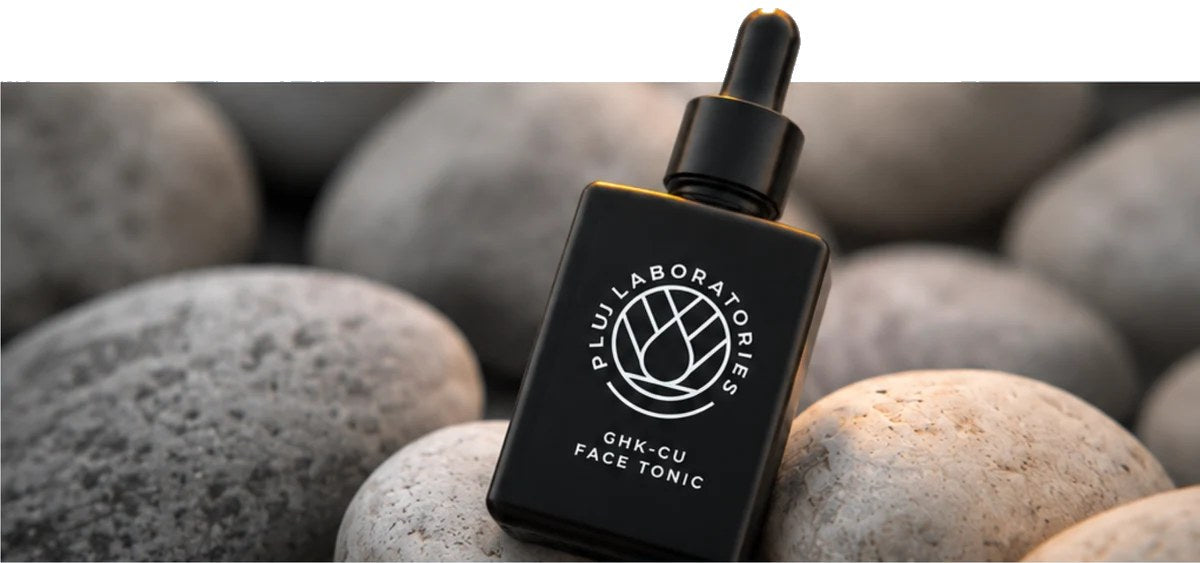
Concentration is the easiest way to narrow it down. Published research on GHK-Cu uses meaningful concentrations, yet so many brands fail to list a concentration on their label. For example, the PLU Laboratories Face Tonic uses 1% GHK-Cu and 3% Palmitoyl Peptides, verified by LC-MS testing at the University of Illinois Chicago. Results are at or above what the label claims.
Other than that, look at the rest of the ingredient list. You want to see a short list of other additives. More ingredients typically just equate to unnecessary fluff in the formula. This is another reason the PLU Laboratories GHK-Cu face serum is a great choice: six ingredients total, and three of them are proven peptides!
PLU Laboratories
Visibly firmer skin, no filler ingredients
Just 6 ingredients. 1% GHK-Cu with Palmitoyl Tripeptide-1 and Palmitoyl Tetrapeptide-7
Shop GHK-Cu Face TonicBest Practices For Application
You can easily layer copper peptides into your existing skincare routine without making any sort of changes. Apply after cleansing and toning. A little goes a long way. You just need 2-3 drops. Massage it into your whole face, but focus on the areas where your acne scars are more prominent.
Let the serum absorb into your skin for at least 30 seconds before following up with the next step - which may be another serum, or your moisturizer/SPF to seal everything in.
Consistency is critical to harnessing the potential of copper peptides for acne scars. You can use them morning or night, as long as you use them every day. You should consider GHK-Cu microneedling to maximize absorption and speed up progress, too.
Complementary Ingredients For Acne Scars
There are a lot of skincare staples you can turn to for easing the appearance of acne scars. Copper peptides play nicely with most of them, but with a few caveats.
- Retinoids (retinol or tretinoin) speed up skin cell turnover, pushing older, scarred skin out and bringing fresh cells to the surface.
- Niacinamide can help with the discoloration that tends to come with scarring.
- Azelaic acid and copper peptides complement each other really well, too, since azelaic acid helps correct pigmentation and supports a healthier inflammatory response.
Just make sure you always follow proper layering guidelines. Thinnest to thickest. That means cleanser, toner, serums, moisturizer.
How Long Until Copper Peptides Improve Acne Scars?
Can copper peptides help with acne scars? The short answer is they have the potential to, but don’t expect an overnight transformation. Most visible changes in scar appearance require 8-12 weeks of consistent daily use to become noticeable.5
We’ve found that scar type matters, too. Shallower ones (rolling/boxcar) are quicker to respond to topical treatment than deeper ones (ice-pick).
This is not to discourage you, but just to make sure you have the right expectations in place before beginning to use copper peptides for acne scars. Stick with it long enough, and you’ll be amazed at the difference down the road!
What Are Professional Treatments For Acne Scars?
Professional treatments may be necessary for deeper scarring. Some common options include:
- Microneedling: Creates controlled micro-injuries to prompt a concentrated healing response. It can also boost topical product absorption afterward.
- Chemical peels: Resurface the outer layers of skin to diminish the appearance of shallower scars.
- Laser treatments (fractional CO2, erbium): Can be really helpful for scarring in deeper tissue as they stimulate significant collagen remodeling.
One thing to be aware of, though, is none of these are mutually exclusive with copper peptides as it pertains to treating acne scars. You can continue to do your at-home skincare while getting regular treatments at a dermatologist’s office.
At the end of the day, there is great promise for copper peptides. Board-certified dermatologist Dr. Jody Levine sums it up well. In addition to supporting collagen production, Levine says, “copper peptides also have anti-inflammatory properties that can help address scarring, pigmentation and redness related to inflammation.”6
So, make a copper peptide serum part of your daily routine. It’ll be one of the best things you do for your skin!

PLU Laboratories
The direct route to firmer-looking skin
Just 6 ingredients. 1% GHK-Cu with Palmitoyl Tripeptide-1 and Palmitoyl Tetrapeptide-7
Shop GHK-Cu Face TonicRelated Resources
Does GHK-Cu help with acne? | Topical peptides for acne
References
- Pickart L, Margolina A. "Regenerative and Protective Actions of the GHK-Cu Peptide in the Light of the New Gene Data." International Journal of Molecular Sciences. 2018;19(7):1987. PubMed
- Pickart L, Vasquez-Soltero JM, Margolina A. "GHK Peptide as a Natural Modulator of Multiple Cellular Pathways in Skin Regeneration." BioMed Research International. 2015. PubMed
- Granite A, MD. Interview. Yahoo Shopping. Source
- "A Systematic Review of the Mechanisms and Therapeutic Applications of GHK-Cu in Topical Microneedle Delivery: A Case for Expanded Clinical Trials." 2026. PubMed
- Mallari K, NP-C. Interview. PureWow. Source
- Levine J, MD. Interview. NewBeauty. Source

Written by Product Team