GHK-Cu for Loose Skin: Does GHK-Cu Help With Loose Skin?
Whether you lost a ton of weight and now have saggy skin or you’ve just noticed that age has cost you the firmness your skin used to have, it can take a toll on your self-confidence. The good news is you may be able to tighten everything back up using GHK-Cu for loose skin.
So how does GHK-Cu help with loose skin? This signaling peptide has been shown to modulate the expression of genes tied to both collagen and elastin production - both of which are necessary for keeping skin firm.1
Natural GHK-Cu levels plummet by 60% between age 20 and 60, so it comes as no surprise that skin firmness goes on a similar timeline.1 We’ll introduce you to not only the benefits of GHK-Cu for skin tightening but also show you the #1 copper peptide serum on the market. Learn more below and restore that supple, firm complexion you once had!
Key Takeaways
- GHK-Cu is a naturally occurring copper peptide with a well-documented role in collagen, elastin, and glycosaminoglycan expression. 1,2
- Natural production of this copper peptide can drop as you get older, tracking with skin changes (and hair changes, for that matter). 1
- GHK-Cu peptide for loose skin is a non-invasive alternative to professional treatments if you’re willing to be patient. Visible changes can take between 6-8 weeks.
- Make sure the GHK-Cu serum you use features meaningful concentrations and doesn’t have fluff/filler ingredients that just get in the way.
- PLU Laboratories makes the #1 copper peptides for skin online.
What Causes Skin to Lose Its Firmness?
There are two reasons the skin could start sagging: weight loss and age. It could even be a combination of the two in some cases!
Weight Loss Transformations
It could be as simple as the aftermath of weight loss. First and foremost, congratulations on a successful weight loss transformation!
It can be quite frustrating, though, when you see the numbers on the scale drop but now you feel as if there’s a new challenge to cope with. While the skin can tighten up on its own if you are patient, you might want to speed up the 6-24 month timeline. More dramatic weight loss transformations - say, more than 3-4lbs a week and over 50lbs total - might mean looking for assistance to get the skin to bounce back.
Loss of Firmness With Age
Then there’s the age side of things. This is something almost everyone is prone to. Your skin’s firmness is dictated by three separate structural components:
- Collagen (tensile strength)
- Elastin (elasticity and snap-back)
- Glycosaminoglycans like hyaluronic acid (hydration and volume)
Your body already makes all three. But you have less and less of each the older you get. Collagen production starts falling off in your mid-20s and really plummets after 40.
Elastin is harder to replace because your body starts making way less post-puberty. What’s left can be broken down by UV exposure and oxidative stress. Same sort of story for glycosaminoglycans.
Eventually, you're left with skin that can no longer bounce back the way it used to. This is why skincare is so important in fighting the visible signs of aging. And it’s where the idea of using GHK-Cu for loose skin comes into the picture.
What is GHK-Cu?
GHK-Cu is short for glycyl-L-histidyl-L-lysine copper. It’s actually a naturally occurring copper peptide that exists in your blood plasma right now (along with your saliva and urine). As the name suggests, it’s three amino acids bound to a copper ion:
- Glycine
- Histidine
- Lysine
This is important because the molecular size of this short-chain peptide is very small. That’s how it’s able to penetrate the skin so well and work with your body’s natural processes.3
GHK-Cu is a signal peptide your body uses to facilitate certain things tied to skin renewal - like tissue repair and remodeling. There’s a ton of evidence behind GHK-Cu for skin. It appears to influence the expression of over 4,000 human genes, including some linked to collagen synthesis, elastin production, and antioxidant defense.1
There are a lot of other exciting copper peptides out there, including AHK-Cu. But nothing has the depth of peer-reviewed data that GHK-Cu does.
Like a lot of the structural proteins involved in skin firmness, though, GHK-Cu levels fall off a cliff with age. You have peak GHK-Cu levels around age 20 (200 ng/mL) but only 80 ng/mL by age 60.1 That drop correlates with a lot of the skin firmness decline you see as you get older.
Does GHK-Cu Help With Loose Skin?
Topical GHK-Cu serums make it easy to turn back the hands of time and restore healthy levels. But does GHK-Cu help with loose skin, or is it too good to be true? Let’s look at what the evidence has to say.
Supporting Collagen Production
Most of the loss in skin firmness can be traced back to collagen loss. We’ve known since the late 1980s that GHK-Cu can directly stimulate collagen synthesis in fibroblast cultures at the per-cell level.2 This doesn’t just mean it increased cell numbers, though - it also made existing cells work harder to produce collagen.
A follow-up study a few years later confirmed these results in vivo. There was a measurable increase in collagen accumulation thanks to GHK-Cu. In fact, collagen synthesis was stimulated at around twice the rate of non-collagen proteins.4
The key takeaway here is that GHK-Cu helped elevate both type I and type III collagen mRNA levels, which are the two types most relevant to skin structure and firmness.
Boosting Elastin and Skin Elasticity
Elastin is the protein that lets your skin stretch and bounce back to its original shape. Skin sags and hangs loose when elastin levels are low. And like we said earlier, elastin starts dropping after puberty. So how does GHK-Cu help with loose skin in this regard?
A 2008 review in Journal of Biomaterials Science documented GHK-Cu’s role in supporting elastin synthesis alongside collagen and growth factor production.5 The researchers concluded that “GHK-Cu stimulates wound healing in numerous models and in humans.”
This is important because it’s a process inherently involved in rebuilding the skin’s elastic framework. Speaking of which…
Rebuilding the Skin's Structural Matrix
Collagen and elastin are just two pieces of the skin puzzle. They exist within a matrix of glycosaminoglycans (GAGs) and proteoglycans, which are paramount for providing hydration, volume, and cohesion to the structure of the skin.
We want to zero in on GAGs - often called the “mortar” between the “bricks” that make up skin. Collagen and elastin cannot hold together without GAGs.
Published research in the Journal of Investigative Dermatology showed GHK-Cu could modulate glycosaminoglycans and the proteoglycan decorin expression in dermal tissue.6
Decorin is in charge of regulating collagen fiber organization. In other words, it helps turn collagen into more structured networks instead of just disorganized clumps that don’t actually support anything.
Gene-Level Signaling
We spoke about how GHK-Cu can modulate gene expression earlier. Of those 4,000+ connections, GHK-Cu can modulate 31.2% of the genes involved in skin remodeling pathways.1
From collagen and elastin to antioxidant and inflammation pathways, GHK-Cu touches so many different elements of skin health. That’s what separates it from a lot of other clinically proven ingredients.
Using GHK-Cu for Loose Skin: Should You Inject it or Apply it Topically?
The case for GHK-Cu for loose skin is strong. It’s just a matter of how you should go about incorporating it into your skincare routine. The crossroads you’ll arrive at is GHK-Cu topical vs injection.
|
Factor |
Topical Application |
Injection |
|
Administration |
At home, 30 seconds/day |
Clinic visit or self-injection |
|
Safety Profile |
Excellent tolerability, minimal side effects |
Injection-site reactions, infection risk, sterility requirements |
|
Cost |
$40-80/month |
$100-300+ per session (compounding pharmacy) |
|
Regulation |
Regulated cosmetic product |
Compounding pharmacy (variable quality control) |
|
Published Research |
Multiple peer-reviewed topical studies |
Limited injection-specific clinical data |
|
Convenience |
No appointment, apply daily |
Needles, reconstitution, cold storage |
|
Onset |
Gradual improvement over 6-8 weeks |
May be faster for some applications |
A lot of people are drawn to the idea of injectable peptides because you get whole-body results, and the results might even be a little more dramatic. But there’s a reason topical peptides are the way to go, especially for something like loose skin.
The Problems With Injections
You can get injectable GHK-Cu from a compounding pharmacy - maybe. The regulatory landscape is constantly changing. What’s accessible today could be restricted within a month or two.
Compounded peptides are different from regulated topical cosmetics in the sense that quality control is very hit or miss. There’s no telling what sort of concentration accuracy, sterility, and shelf stability you’re getting.
There are risks that come with any sort of injections that just don’t exist with topicals, too:
- Site infections
- Bruising
- Incorrect dosing
That’s not to mention the hassle of figuring out reconstitution and dealing with storage. Reconstituted GHK-Cu (ready to inject) has a very finite shelf life, as it’s susceptible to degradation under light and oxygen.
But at the end of the day, there’s really one reason we recommend topical GHK-Cu peptide for loose skin - it’s where most of the evidence comes from! Extrapolating those results to injectable use is a reach.
Why We Recommend Topical Treatment
Maybe your skin is loose everywhere. But it’s more likely you’re dealing with sagging skin in very specific areas. Your chin, neck, cheeks, etc. Applying a topical gives you way more control over where you’re putting the GHK-Cu.
It’s also just a more practical addition to your daily routine. All it takes is a few drops, massaged into the skin for 30 seconds, morning or night. No real adverse reactions to stress about. No need to poke yourself with a needle all the time.
Plus, you can rest assured you’re actually making the most of GHK-Cu for loose skin. A 2016 study found that topically applied GHK-Cu reduced wrinkle volume by 55.8% and wrinkle depth by 32.8%.7 Read carefully: topically applied GHK-Cu. Not injections.
The best part is you can get started right here, right now. You don’t have to visit a clinic or find a compounding pharmacy near you. You can order copper peptides for skin in just a few clicks at PLU Laboratories.
What Separates PLU Laboratories GHK-Cu Serum For Loose Skin?
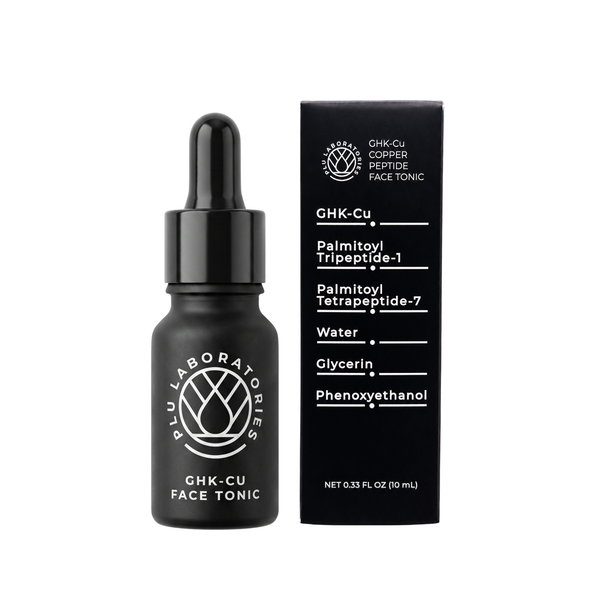
Our GHK-Cu serum (1%) also has Palmitoyl Peptides (Tripeptide-1 and Tetrapeptide-7, 1% concentration). It has just two carriers and no fluff or filler. This lets the peptides work uninhibited.
The serum has a 4.8/5 star rating and multiple independent clinician reviews. For example, Dr. Christy Arthur says, “What I like about this Face Tonic from PLU Laboratories is how simple and focused the formula is. Of the six ingredients, three of them are signaling peptides, which are believed to support healthier or firmer-looking skin over time.”
The Face Tonic is also independently lab-tested for concentration and purity. You can shop with confidence knowing you’re getting the safe, effective solution you need to bring out the best in your skin.
PLU Laboratories
Visibly firmer skin, no filler ingredients
Just 6 ingredients. 1% GHK-Cu with Palmitoyl Tripeptide-1 and Palmitoyl Tetrapeptide-7
Shop GHK-Cu Face TonicGHK-Cu Loose Skin Before and After: When Can You Expect Results?
It’s clear that GHK-Cu for loose skin can work wonders. But it’s also important that you set your expectations regarding any sort of GHK-Cu loose skin before-and-after transformation. It’s not something that will happen overnight, or even within a few weeks, for that matter.
We get asked all the time, how long does GHK-Cu take to work? While everyone’s experience with GHK-Cu peptide for loose skin is different, here’s a look at the typical timeline.
Weeks 1-2
Your skin feels smoother and more hydrated. GHK-Cu is already starting to talk to skin cells and activate repair pathways. But you won’t see any sort of visible improvements in firmness yet.
Weeks 3-4
This is when you might start noticing a visible change in texture. Nothing dramatic. But the skin may look more even, perhaps a little more refined. Collagen and GAG production are starting to ramp up at the cellular level, and the snowball effect is underway as the results just become more and more apparent the longer you stick with it.
Weeks 5-6
We tell patients using GHK-Cu for loose skin to give it at least 6 weeks before making any sort of conclusions regarding their GHK-Cu loose skin before-and-after transformation. Because it’s at this point that skin starts to feel tighter to the touch. You may even notice fine lines looking less prominent.
Week 7 and Beyond
Research suggests that GHK-Cu's benefits compound over time as the structural matrix continues to rebuild.1 We highly recommend you stick with the treatment for the long haul. A lot of customers tell us the results just keep getting better and better over a 12-week period of time.
Then, it’s about maintaining healthy GHK-Cu blood plasma levels. The reason we recommend using topical GHK-Cu for loose skin is you can continue using it for maintenance without any sort of impact on your day-to-day routine.
Setting Expectations: Factors Influencing Your Results With GHK-Cu for Loose Skin
We’ve witnessed our fair share of GHK-Cu loose skin before-and-after success stories. But in the interest of transparency, we want to be very clear that not everyone will have the same dramatic transformation. There are several factors influencing the degree of your results.
How Loose is Your Skin?
We mentioned at the very beginning of this guide to GHK-Cu peptide for loose skin that dramatic weight loss results (more than 50lbs in a short period of time) might require professional treatments.
On the other hand, mild laxity still responds really well to topical peptides. Think early softening of the neck skin, minor sagging along the jawline, or an overall loss of “bounce.”
Age Plays a Role
Younger skin has a stronger starting point because it has more baseline collagen and elastin - and it has more GHK-Cu for that matter.
That’s not to say that older skin doesn’t benefit from GHK-Cu for loose skin. In fact, it’s the best case for using GHK-Cu. You just have to be more patient and temper expectations.
Your Genetics Matter
There’s a genetic component to aging. Some people just hold onto more of their collagen and elastin than others. That dictates how fast loose skin develops and how responsive it is to peptide treatment.
Nutrition, Hydration, and Lifestyle
Peptides are just one variable you can control to tighten up loose skin. Collagen production requires you to consume ample protein and vitamin C, and you must stay hydrated. Otherwise, your body doesn’t have the raw materials for synthesis - so no amount of GHK-Cu will help.
You should protect yourself from the sun as much as you can, too. Remember - UV rays can take a toll on existing collagen and elastin. Other advice we want to offer is to get regular exercise, stop smoking, and find healthy ways to manage stress. The more you do, the better your GHK-Cu loose skin before-and-after results will be!
Should You Layer GHK-Cu With Other Peptides For Loose Skin?
You came here curious about GHK-Cu for loose skin specifically. But this is just one of the many peptides you have at your disposal if you’re interested in taking things further.
GHK-Cu and BPC-157
BPC-157 (Body Protection Compound-157) is a 15-amino-acid synthetic peptide that, as the name suggests, is made for stimulating tissue repair.8
The idea behind combining these peptides is that BPC-157 helps heal damaged tissue while GHK-Cu encourages the rebuilt tissue to firm up. You should take the time to learn more about GHK-Cu vs BPC-157 before committing to the combination, though.
What’s the GLOW Protocol?
This peptide-stacking regimen brings together GHK-Cu and BPC-157 with one other peptide - TB-500 (Thymosin Beta-4). It’s usually a 5:1:1 ratio with GHK-Cu being the dominant peptide, since that’s where most of the skin benefits are proven.
What started in biohacking forums has become pretty popular online. A lot of compounding pharmacies will dispense this protocol. But, there’s no clinical research behind it - and for the most part, GLOW is an injectable peptide protocol.
Other Potential Benefits of GHK-Cu
Loose skin aside, there are so many other things GHK-Cu can do that earn it a spot in your skincare (and perhaps even haircare) routine. Here’s a quick look at all that we know the copper peptide to be capable of:
- Improving the appearance of fine lines7
- Encouraging the skin’s natural renewal and remodeling processes 1
- Bolstering antioxidant defense through gene modulation 1
- Promoting the appearance of healthier-looking skin texture3
We’ve seen more and more people start using GHK-Cu for hair growth, too! You can learn all about the GHK-Cu benefits in our blog if you want to see all that it can do.
Is GHK-Cu Safe?
You can enjoy peace of mind using GHK-Cu for loose skin - that is, if you do so with a high-quality, lab-tested topical solution. Copper peptides in general have a very strong safety profile when used directly on the skin. The only side effects we’ve seen reported are:
- Mild redness
- Minor itching
- Slight dryness
These tend to get better within a few days - it’s a little bit of an adjustment phase. Nothing quite as severe as, say, retinoids. But one thing you’ll want to be careful with is layering GHK-Cu in the same routine as stronger actives like retinol or vitamin C. This can block the peptide from getting through the skin barrier.
Frequently asked questions
Can copper peptides help with loose skin?
Yes, GHK-Cu has ample research showing it can support firmer-looking skin through multiple pathways including collagen, elastin, and glycosaminoglycan expression.1,2,5 It’s a safe, non-surgical solution for tightening loose skin.
What peptide is best for loose skin?
We think GHK-Cu is the best peptide for loose skin given that most copper peptides skin benefits are specifically referring to this one.1 But, we also recognize that the best copper peptide serum may not be GHK-Cu in isolation. That’s why PLU Laboratories includes palmitoyl peptides in the serum.
How much GHK-Cu for loose skin?
1% GHK-Cu is the ideal concentration for topical use. More is not necessarily better. In fact, it could just raise the likelihood of side effects. Low and slow is the way to go.
How long does it take for GHK-Cu to tighten skin?
Anywhere from 3-4 weeks for early signs of improvement to 6-8+ weeks for more dramatic GHK-Cu loose skin before-and-after transformations.
When should I explore other methods for tightening skin?
If you have lost more than 50 lbs in a very short period or have given GHK-Cu at least 2-3 months of consistent daily use with no signs of progress at all. You may want to consider professional treatments like RF microneedling, ultrasound therapy, and surgical options.
Are there any side effects of GHK-Cu for loose skin?
Not if you use the peptide topically. GHK-Cu has a very strong safety profile. Injectable GHK-Cu is another story, and we don’t advocate for injecting any sort of peptides from a compounding pharmacy (or sketchy online retailer, for that matter).
Where can I find GHK-Cu loose skin serums?
Look no further than PLU Laboratories. We’ve formulated our GHK-Cu serum with 1% concentration and paired with palmitoyl peptides for well-rounded results. You won’t find any fluff or filler on the ingredients label, though, which is really what sets PLU apart.
Does GHK-Cu work well alongside professional treatments like microneedling?
Yes, you can combine GHK-Cu with microneedling to maximize absorption. Some experts suggest applying topical peptides after sessions to better support the healing and remodeling processes GHK-Cu is linked to.
Will the skin-tightening effects of GHK-Cu last forever?
No. GHK-Cu supports your skin's natural processes while it’s in the blood plasma - but those processes may slow down if you take away the peptide support. The good news is it’s easy to commit to using GHK-Cu for loose skin for the long haul. Just 30 seconds a day is all it takes!

PLU Laboratories
The direct route to firmer-looking skin
Just 6 ingredients. 1% GHK-Cu with Palmitoyl Tripeptide-1 and Palmitoyl Tetrapeptide-7
Shop GHK-Cu Face TonicReferences
- Pickart L, Margolina A. Regenerative and Protective Actions of the GHK-Cu Peptide in the Light of the New Gene Data. Int J Mol Sci. 2018;19(7):1987. PubMed
- Maquart FX, Pickart L, Laurent M, Gillery P, Monboisse JC, Borel JP. Stimulation of collagen synthesis in fibroblast cultures by the tripeptide-copper complex glycyl-L-histidyl-L-lysine-Cu2+. FEBS Lett. 1988;238(2):343-346. PubMed
- Pickart L, Vasquez-Soltero JM, Margolina A. GHK Peptide as a Natural Modulator of Multiple Cellular Pathways in Skin Regeneration. Biomed Res Int. 2015;2015:648108. PubMed
- Maquart FX, Bellon G, Chaqour B, et al. In vivo stimulation of connective tissue accumulation by the tripeptide-copper complex glycyl-L-histidyl-L-lysine-Cu2+ in rat experimental wounds. J Clin Invest. 1993;92(5):2368-2376. PubMed
- Pickart L. The human tri-peptide GHK and tissue remodeling. J Biomater Sci Polym Ed. 2008;19(8):969-988. PubMed
- Simeon A, Wegrowski Y, Bontemps Y, Maquart FX. Expression of glycosaminoglycans and small proteoglycans in wounds: modulation by the tripeptide-copper complex glycyl-L-histidyl-L-lysine-Cu(2+). J Invest Dermatol. 2000;115(6):962-968. PubMed
- Badenhorst T, Svirskis D, Merrilees M, Bolke L, Wu Z. Effects of GHK-Cu on MMP and TIMP Expression, Collagen and Elastin Production, and Facial Wrinkle Parameters. J Aging Sci. 2016;4:166. DOI
- Seiwerth S, Milavic M, Vukojevic J, et al. Stable Gastric Pentadecapeptide BPC 157 and Wound Healing. Front Pharmacol. 2021;12:627533. PubMed

Written by Product Team